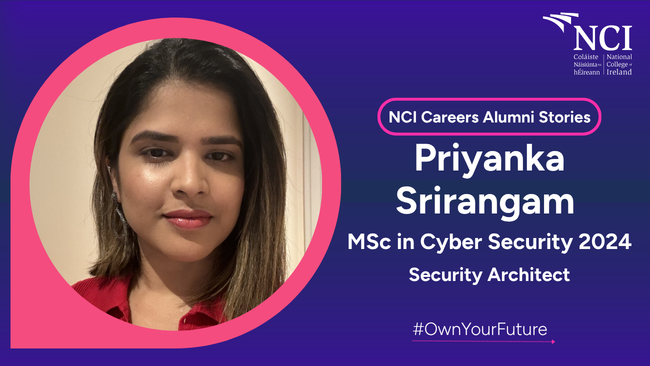
Priyanka is an MSc Cyber Security graduate from NCI. Originally from India, she began her career as a Software Engineer with Tata Consultancy Services before moving to Infosys. After relocating to Ireland, she continued her career with AIB, today, she works as an Enterprise Security Architect.
Tell us a little bit about yourself and your background:
I am an Enterprise Security Architect at Allied Irish Banks (AIB), based in Dublin, where I focus on emerging security domains including AI security, post-quantum cryptography, data security, and operational resilience.
My career began in India as a software engineer with Tata Consultancy Services (TCS), working across GE Healthcare and GE Digital. I later joined Infosys, where I progressed through a range of roles from Senior Developer to Solution Architect, gaining exposure to large-scale technology transformation programmes and complex enterprise environments.
Through these experiences, I developed a strong interest in cybersecurity and technology architecture, which eventually led me to specialise in security. After joining AIB as a Technical Architect and later a Solution Architect, I transitioned into Enterprise Security Architecture, where I now lead and shape strategy across Data and AI Security domains.
Outside my day-to-day role, I actively contribute to international industry forums, including the Quantum Safe Financial Forum, and regularly participate in cybersecurity discussions, round tables, and working groups focused on topics such as AI security and the future of cyber resilience.
What made you choose Ireland as a place you wanted to work?
Ireland's technology growth over the past few decades was the main draw. Many global decisions in technology, payments, and cloud services are made from Dublin, meaning the work here is genuinely at the forefront of these industries. As a technology hub, Ireland also provides strong exposure to innovation and regulatory developments across Europe.
Beyond the work itself, Ireland is welcoming to people building international careers. The cybersecurity and fintech communities are also small enough that you can build meaningful professional relationships across organisations, learn from peers, and contribute to industry conversations.
What was your most memorable experience from your time at NCI ?
My Master's programme at NCI coincided largely with the COVID-19 lockdown period, so most classes and interactions with peers took place online. Despite that, I made the most of every opportunity to engage with faculty and fellow students.
I particularly enjoyed the collaboration involved in group projects, and there was a shared sense of camaraderie during the Research semester as we collectively navigated unfamiliar challenges. Several lecturers also left a lasting impression through both their teaching approaches and broader discussions around the subject matter.
Overall, it was an enriching two-year journey filled with challenging content, valuable learning experiences, and meaningful connections. The graduation ceremony was especially memorable. Celebrating the achievement with my loved ones present, meeting many classmates in person for the first time, and sharing the day together made it a truly special occasion.
How did you hear about your role?
I initially joined AIB through Infosys, working on the Mortgages technology platform as a Senior Developer. Over time, I transitioned directly into AIB as a Solution Architect before moving internally into my current Enterprise Security Architecture role.
My Master's degree in Security, combined with a deep understanding of the bank's technology landscape, helped support that progression. I subsequently moved into the Enterprise Security and Resilience function, where I currently lead and shape the Data and AI Security domains.
It was not a single moment of hearing about a role, but rather a progression built through dedication, continuous learning, and the support of colleagues and mentors who encouraged my development along the way.
What did the recruitment process involve and how did you prepare for it ?
My general advice for interviews is to research the target organisation thoroughly, understand the specific technology and security challenges it faces, and be able to articulate not just what you have built, but the thinking behind your decisions.
At senior levels, interviews are often conversations between peers rather than examinations. The best preparation is to be clear about your experiences, your perspective, and the reasoning behind your professional decisions.
Can you describe the visa process you underwent ?
Visa journeys are often unique to each individual entering the Irish job market from India. For me, the journey began during my time with Infosys.
I moved to Ireland from Pune on an Intra-Company Transfer (ICT) permit, which granted me a Stamp 1 permission. I remained on this permit for nearly four years while building my experience and profile within AIB through a variety of technology roles.
When I accepted a permanent position with AIB as a Solution Architect, I transitioned to a Critical Skills Employment Permit. After holding that permit for two years, I became eligible for and subsequently moved to a Stamp 4 permission, which I currently hold.
What is a typical day like in your current role?
There is not really a typical day, which is one of the aspects I enjoy most about the role.
Some days are spent designing security architecture for new capabilities the bank is developing. Other days involve architecture governance activities, reviewing major technology programmes from a security perspective, or working directly with engineering teams on secure design practices.
I also participate in industry working groups with peer European banks on topics such as quantum-safe cryptography, as well as engaging with technology vendors on platform security concerns and strategic roadmaps.
The common thread across all of these activities is translating where security is heading into practical decisions that the bank can act on today. One of the greatest challenges is the pace of change across technology and cybersecurity, particularly in areas where technologies such as AI are simultaneously creating new opportunities and new risks.
What do you enjoy most about your current role?
Cybersecurity is one of the few professions where you are genuinely working at the edge of what is known. The threats evolve, the technology evolves, and the regulatory environment evolves. There is always something new to learn.
I particularly enjoy working in emerging domains where there is no established blueprint yet. AI security and post-quantum cryptography are excellent examples. Success requires understanding the evolving landscape, collaborating with peers across the industry, and developing practical solutions despite uncertainty.
Solving complex problems is one of the key reasons many of us are drawn to cybersecurity, and the opportunity to do that every day remains one of the most rewarding aspects of the profession.
What has been the most challenging part of your graduate journey ?
Translation has been both the most challenging and the most rewarding aspect of my professional journey.
Throughout my career, I have had to translate between technology and business audiences, security concepts and engineering realities, enterprise architecture and security controls, and more recently, emerging technology developments for senior stakeholders.
Moving fully into security from a technology and architecture background was not simply about learning new technical content. It involved developing a risk-based mindset, understanding what matters most in different situations, knowing when to challenge and when to enable, and communicating complex concepts to audiences with different perspectives and priorities.
That judgement is developed through experience, continuous learning, and being honest about what you know and what you still need to learn.
Top 3 tips for students and graduates entering the Irish job market ?
1. Careers are rarely linear.
The early years of your career are about discovering what genuinely interests you. You will not enjoy every task you are assigned, but pay attention to the projects that spark your curiosity and motivate you to learn more. Those interests often point towards the next pivot in your career journey.
2. Never stop learning.
The rise of AI assistants can make it seem as though any task can be completed without developing deep expertise. However, organisations still need skilled developers, security engineers, penetration testers, architects, and data scientists. Technology is most powerful when combined with strong foundational knowledge and critical thinking.
3. Build strong fundamentals and stay adaptable.
Every wave of technological change reshapes the skills that are in demand. However, successful and sustainable technology transformations take time, and professionals with strong core skills, resilience, and a willingness to adapt will continue to thrive. Continuous learning, combined with practical experience, remains one of the most valuable investments you can make in your career.